Imagine a customer reports a defect in a finished product. Your quality team needs to identify the affected batch, determine which raw materials were used, find the production records, and establish which other products might be affected.
If that information is spread across spreadsheets, paper registers, disconnected machines, and separate departments, the investigation can become slow and complicated.
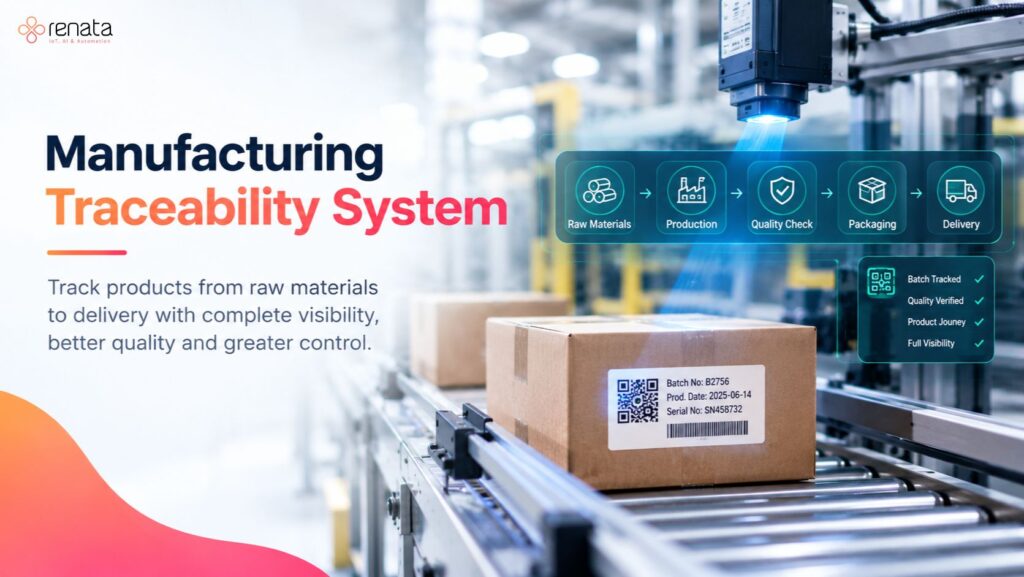
A manufacturing traceability system helps connect product identity with the materials, production processes, quality checks, and movement records associated with that product. Instead of searching through disconnected records, manufacturers can build a clearer picture of a product’s journey through the factory and, where data is available, beyond it.
For manufacturers looking to improve quality visibility, batch tracking, and operational accountability, traceability is more than a record-keeping exercise. It is a way to connect what happened on the shop floor with the information needed to make better decisions.
In this guide, we explain how manufacturing traceability works, which technologies support it, what data to capture, how to implement a system, and what to evaluate when choosing an industrial traceability solution.
What Is a Manufacturing Traceability System?
A manufacturing traceability system records and connects information about materials, components, production activities, batches, finished products, and relevant movement events throughout the manufacturing process.
Depending on the application, a traceability record may include:
- Raw material supplier and material lot number
- Component or product identification
- Production line, machine, or work centre
- Manufacturing date, time, and batch number
- Process parameters and production records
- Inspection results and quality approvals
- Rework, rejection, or non-conformance records
- Packaging, dispatch, and shipment information
The purpose is to make it possible to retrieve the relevant history of a product or batch when required.
For example, if a particular component fails inspection, a manufacturer may need to identify the production batches that used that component, check the associated quality records, and determine whether finished products require further investigation.
The exact level of traceability depends on the industry, product risks, customer requirements, and applicable regulations. Some operations need batch-level traceability, while others require individual serial-number tracking.
Why Is Traceability Important in Manufacturing?
Manufacturing processes often involve multiple materials, machines, operators, inspections, and production stages. When records are disconnected, it becomes harder to establish which inputs were used, what happened during production, and which finished products may be affected by a problem.
A structured traceability system can help address several operational challenges.
1. Faster product investigations
When a quality issue occurs, connected records help teams locate relevant production and material information more efficiently. This can support investigations into the origin, scope, and possible cause of a defect.
2. Better batch and lot tracking
Batch-level records help manufacturers associate raw materials and components with the products made from them. This information is particularly useful when investigating supplier issues, process deviations, or product-quality concerns.
3. Improved quality visibility
Connecting inspection results with product and production records helps teams review where a defect occurred and whether similar products or batches may need attention.
4. More controlled product recalls
If a recall or withdrawal becomes necessary, traceability information can help identify the affected products and relevant distribution records. The effectiveness of this process depends on data completeness, identification practices, and the quality of links between production and dispatch records.
5. Better accountability across production stages
When important production events are recorded with timestamps, machine or process identifiers, and relevant approvals, teams can review the sequence of activities and investigate deviations.
6. Stronger operational decision-making
Traceability data can help quality, production, and supply-chain teams understand recurring issues, identify gaps in record-keeping, and improve process controls.
Traceability does not automatically prevent defects or guarantee compliance. It provides the information needed to investigate issues, demonstrate recorded activities, and make better-informed decisions.
How Does a Manufacturing Traceability System Work?
A practical traceability process connects product identification with recorded events throughout production and distribution.
Step 1: Identify materials, components, and products
The first step is to assign or capture identifiers for the items being tracked.
These may include supplier lot numbers, material codes, component identifiers, batch numbers, serial numbers, or product codes. The identification method should match the level of traceability required.
For example, a factory producing thousands of identical components may track production by batch, while a manufacturer of high-value equipment may need to identify each individual unit.
Step 2: Record incoming materials
When materials arrive, the system can capture relevant information such as supplier, material identity, lot number, receipt date, and inspection status.
This creates a record that can later be connected to the production batches or products in which the material is used.
Step 3: Link materials to production orders and batches
During production, manufacturers need a reliable way to connect incoming materials and components with the batches or individual products that consume them.
This relationship is essential. Recording a material lot and a finished-product batch separately is not enough unless the system can establish which material lot was used for which output.
Step 4: Capture key production events
As products move through manufacturing, the system records relevant events such as processing, assembly, inspection, rework, and completion.
Depending on the process, data may be entered by operators, captured through barcode scans, obtained from connected equipment, or exchanged with existing manufacturing systems.
Step 5: Connect inspection and quality records
Inspection results, approvals, non-conformances, and rework records can be associated with the relevant product, batch, process, or production order.
This helps quality teams review the recorded history of a product rather than searching for unrelated documents.
Step 6: Record packaging and dispatch
When finished products are packaged and shipped, their identifiers can be linked to cartons, pallets, shipment records, and customer or destination information where applicable.
This extends traceability beyond production and can help teams identify where affected products were sent.
Step 7: Retrieve the product history when needed
When an issue occurs, authorised users should be able to search by a relevant identifier—such as a batch number, serial number, or material lot—and retrieve the associated records.
The value of the system depends on the completeness and accuracy of the links between these records.
Forward Traceability vs. Backward Traceability
Manufacturers often need to answer two different questions: where did a product’s inputs come from, and where did the finished product go?
Traceability direction | Main question | Example |
Backward traceability | Which materials, components, or processes contributed to this product? | Identify the supplier lot used in a defective batch |
Forward traceability | Which products or shipments contain this material or component? | Identify finished batches that used an affected material lot |
Both directions matter during quality investigations.
Backward traceability helps establish product history and investigate possible causes. Forward traceability helps define the potential scope of an issue and identify the products that may require further investigation.
A well-designed manufacturing traceability system connects both directions through reliable relationships between incoming materials, production batches, finished products, and dispatch records.
Technologies Used in Industrial Traceability Software
The technology should support the traceability process—not determine it. Manufacturers should first establish what needs to be identified and which events must be recorded.
Barcodes and QR codes
Barcodes and QR codes provide a practical way to identify materials, components, work-in-progress items, and finished products. Operators can scan identifiers at receiving, production, inspection, packaging, or dispatch points.
The identifier can link to the relevant digital record, reducing reliance on manual searches.
RFID technology
Radio-frequency identification (RFID) can support identification and data capture without requiring every item to be scanned individually with a conventional barcode reader. Its suitability depends on the tag, reading environment, material, item movement, and required accuracy.
Industrial IoT sensors and connected equipment
Connected equipment can provide useful production and process data, such as machine status, timestamps, and selected operating parameters. When appropriately integrated, this data can supplement product and batch records.
However, sensor data alone does not establish complete product traceability. It must be linked to the correct production order, batch, component, or serialised product.
Manufacturing execution and enterprise systems
Manufacturing execution systems (MES), enterprise resource planning (ERP) platforms, quality systems, and warehouse systems may each contain part of the information required for traceability.
Integration can connect these records so that authorised users can follow the relevant product history across systems.
Centralised dashboards and reporting
A shared interface can help users search for product or batch records, review production events, and identify missing information. Dashboards are most useful when they provide accurate underlying records and clear links between related items.
Digital data exchange and standards
For organisations that need to exchange traceability information across suppliers and customers, common data structures and identifiers can improve interoperability.
The GS1 Traceability Standards describe traceability concepts including Critical Tracking Events (CTEs) and Key Data Elements (KDEs). These help organisations define which events to record and what information should accompany them.
The appropriate technology mix depends on product type, process complexity, existing systems, and the traceability requirements of the business.
What Information Should a Traceability System Capture?
The right data model is more important than collecting the largest possible amount of data.
A useful starting point is to identify the information required to answer your most important traceability questions.
Data category | Example information | Why it matters |
Product identity | Product code, serial number, batch number | Identifies the item being traced |
Material identity | Supplier, material code, lot number | Connects inputs to production outputs |
Production events | Process step, date, time, production order | Establishes the manufacturing sequence |
Equipment and process | Machine ID, relevant operating records | Supports process investigation where applicable |
Quality records | Inspection result, approval, non-conformance | Connects quality outcomes to products and batches |
Rework and disposition | Rework record, rejection, release status | Shows how exceptions were handled |
Packaging and shipment | Carton or pallet ID, shipment reference, destination | Supports downstream tracking |
Not every application needs all these fields. The data should reflect the product, manufacturing process, risks, customer expectations, and relevant legal or regulatory requirements.
For each important event, consider recording what happened, which item or batch was involved, when and where it happened, and any additional information needed to interpret the event.
How to Implement a Manufacturing Traceability System
A phased implementation helps manufacturers establish reliable traceability without attempting to digitise every process at once.
Step 1: Map the current manufacturing process
Document how materials enter the facility, move through production, undergo inspection, become finished products, and leave the site.
Identify the points where products or materials change status, are combined, split into batches, reworked, or transferred between locations.
Step 2: Define the traceability requirements
Decide which items need to be tracked and whether batch-level, lot-level, or individual serial-number tracking is appropriate.
Identify the questions the system must answer, such as which material lot was used in a product or which finished batches contain a specific component.
Step 3: Assess existing records and systems
Review the data currently held in ERP, MES, quality systems, spreadsheets, paper forms, and machine controllers.
Identify duplicate records, missing identifiers, manual handoffs, and gaps between production and dispatch information.
Step 4: Establish identification and data-capture methods
Choose suitable identifiers and capture methods for each process step. Depending on the environment, this may involve barcode scanning, QR codes, RFID, operator input, or connected equipment.
Define how records will be validated and what happens when a scan, identifier, or required data field is missing.
Step 5: Connect records across production
Establish the relationships between incoming materials, production orders, process events, inspection records, finished goods, and shipments.
Test whether users can follow these relationships in both directions. If a material lot is flagged, can the team identify potentially affected outputs? If a finished batch is flagged, can the team retrieve the relevant input and production history?
Step 6: Pilot the system on a defined product or line
Choose a manageable product family, production line, or traceability problem. Test the system under real operating conditions and confirm that the recorded events accurately reflect the physical process.
Include exceptions such as rejected items, rework, split batches, merged batches, and corrections where they apply.
Step 7: Train users and define responsibilities
Operators, quality teams, stores personnel, and dispatch teams should understand which events they are responsible for recording and how to handle exceptions.
A traceability system is only as dependable as the process and data practices supporting it.
Step 8: Measure results and expand
Evaluate data completeness, record retrieval time, traceability gaps, and the effort required to investigate a product or batch.
Correct the problems discovered during the pilot before expanding to other lines, product families, or facilities.
How to Choose Industrial Traceability Software
When evaluating industrial traceability software, focus on whether it fits the actual manufacturing process and can establish the relationships your team needs.
Use this checklist when assessing possible solutions:
- Product and batch identification: Can the system support the required batch, lot, or serial-number structure?
- Material-to-product linkage: Can it connect incoming materials and components to the relevant production outputs?
- Production event capture: Can it record the required manufacturing, inspection, rework, and dispatch events?
- Integration: Can it exchange the necessary data with existing ERP, MES, quality, or other operational systems?
- Search and retrieval: Can authorised users retrieve a product or batch history efficiently?
- Data quality: Can the system flag missing, inconsistent, or invalid identifiers and records?
- Access control: Can access to sensitive production and supplier information be managed appropriately?
- Reporting: Can it provide useful traceability records for investigations, audits, and internal reviews?
- Implementation support: Is there a practical plan for mapping processes, testing integrations, training users, and maintaining the system?
Ask vendors to demonstrate a realistic traceability scenario using your own process requirements. For example, request a demonstration of how the system would identify all relevant production batches that used a particular incoming material lot.
This is more useful than comparing feature lists without testing the actual workflow.
If you are assessing connected traceability and production visibility for your facility, explore Renata’s manufacturing traceability solutions.
Common Traceability Challenges and How to Address Them
Inconsistent product identifiers
Different departments may use different codes for the same material, batch, or product.
What to do: Establish clear identification rules, define ownership of master data, and validate identifiers at the points where records are created.
Missing links between materials and finished goods
A system may record incoming material and finished production separately without connecting them.
What to do: Define how material consumption, batch creation, assembly, and rework events must link inputs to outputs. Test these relationships with real production scenarios.
Excessive manual data entry
Repeated manual entry can introduce errors and create gaps when busy operators miss a recording step.
What to do: Use scanning or system integration where practical, while retaining suitable validation and exception-handling procedures.
Disconnected production systems
Production, quality, warehouse, and dispatch records may be stored in separate platforms.
What to do: Map the required data exchange and define the identifiers and event information that must be shared. Integration should be designed around the traceability questions the business needs to answer.
Incomplete traceability during rework or batch splitting
Products may be reworked, repacked, combined, or divided into smaller batches. If these changes are not recorded, product history can become unreliable.
What to do: Define how transformations and exceptional production events are recorded, including the relationships between original and resulting items or batches.
Limited user adoption
A technically capable system may fail to deliver value if the recording process is confusing or creates unnecessary work.
What to do: Involve operators and quality teams in the design, simplify routine workflows, and train users on both the process and the reasons behind it.
Manufacturing Traceability: KPIs to Track
Measure traceability performance using clear, consistently defined indicators.
KPI | What it measures |
Traceability record completeness | Whether required events and fields are recorded |
Batch-history retrieval time | How quickly the relevant product or batch records can be retrieved |
Material-to-product linkage rate | The proportion of relevant production records with valid input-output relationships |
Data correction rate | How often traceability records require correction |
Investigation time | The time needed to establish the scope and history of a product issue |
Unresolved traceability gaps | Missing or incomplete links identified during testing or investigation |
Establish a baseline before implementation and compare it with results after the pilot. Define each measure consistently so that improvements can be evaluated fairly.
The objective is not simply to generate more records. It is to make product history more complete, accessible, and useful when manufacturing teams need it.
Frequently Asked Questions
What is a manufacturing traceability system?
A manufacturing traceability system records and connects information about materials, production activities, batches, finished products, quality checks, and relevant movement events so that authorised users can retrieve a product’s history.
What is the difference between product traceability and batch traceability?
Product traceability may follow an individual product using a unique serial number. Batch traceability follows a defined group of products or materials made or handled together. The appropriate method depends on the product, risk, process, and business requirements.
How does IoT improve traceability in manufacturing?
Industrial IoT can contribute machine status, timestamps, and relevant process data to traceability records. To create useful product history, this information must be connected to the correct product, batch, or production order.
Can traceability software integrate with ERP and MES?
It can, provided the systems and integration methods are compatible. The implementation should define which identifiers and records are exchanged, how data quality is maintained, and how errors are handled.
Is a manufacturing traceability system necessary for every factory?
The appropriate level of traceability varies by industry, product risk, customer requirements, and applicable regulations. Manufacturers should determine what they need to identify and retrieve before selecting a system.
How long does it take to implement a traceability system?
Implementation time depends on the number of production lines, existing systems, data quality, identification methods, and integration complexity. A focused pilot can help establish the requirements and effort before a wider rollout is planned.
What should manufacturers look for in traceability software?
Prioritise reliable product identification, material-to-product relationships, production event capture, quality records, integrations, search and retrieval, access control, and a practical implementation plan.
Final Takeaway
A manufacturing traceability system helps connect the journey of materials and components to the production history of finished products. When the right information is captured and linked consistently, manufacturers can investigate quality issues more effectively, identify potentially affected batches, and improve visibility across production and dispatch.
The best starting point is to identify the traceability questions your factory must answer, map the records needed to answer them, and test the approach on a defined product or production line.
Want to improve product and batch visibility in your manufacturing operations? Explore Renata’s traceability solutions or contact the Renata team to discuss your manufacturing requirements.
Further reading
- GS1 — Traceability Standards: Concepts and standards for connecting product identifiers, traceability events, and supply-chain information.
- GS1 — Global Traceability Standard: Guidance for designing traceability systems and sharing relevant data across supply chains.
- NIST — Supply Chain Traceability Principles: A Manufacturing Meta-Framework: A framework for organising and linking traceability data across manufacturing supply chains.
Implementation requirements vary by product, sector, and jurisdiction. Confirm applicable regulatory and customer requirements with the appropriate quality, compliance, and technical teams.