Product quality is one of the most important parts of manufacturing. A small scratch, incorrect component, surface mark or missing part can affect the finished product and lead to rework, rejection or customer complaints.
Many manufacturers still depend on operators to visually inspect products at different stages of production. Manual inspection is useful, but checking every product consistently can become difficult when production volumes are high, inspection conditions change or defects are difficult to identify.
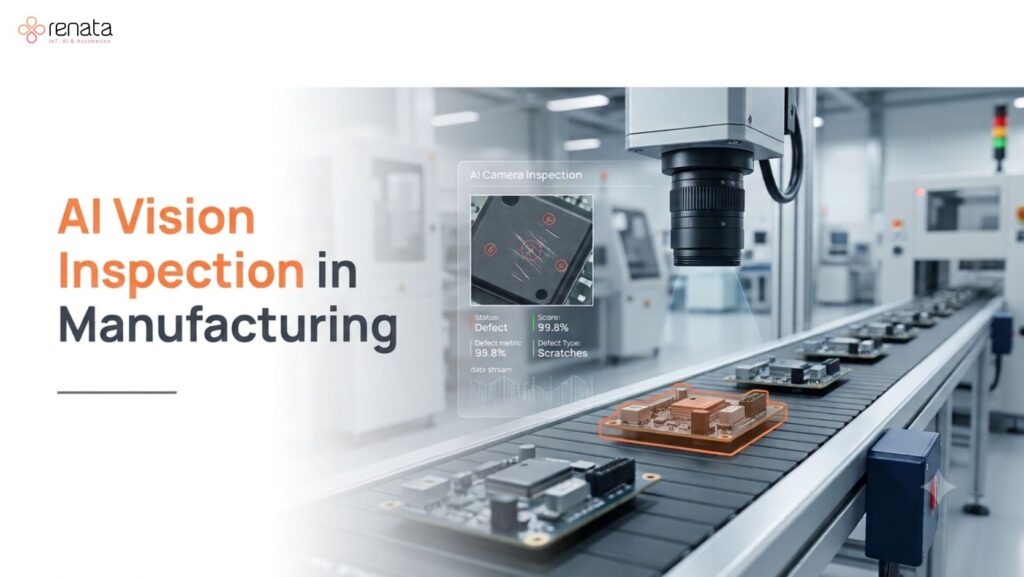
AI vision inspection offers another approach. It uses cameras and artificial intelligence to examine images or video, identify selected defects and highlight products or situations that require attention.
Depending on the application, manufacturers can use AI vision to inspect product surfaces, check component presence, identify visual abnormalities and monitor selected production activities.
This guide explains how AI vision inspection works, where it can be used and what manufacturers should consider before implementing it.
What Is AI Vision Inspection in Manufacturing?
AI vision inspection is the use of cameras, image processing and artificial intelligence models to examine products or manufacturing processes for specific visual conditions.
A camera captures an image or video of the product. The system processes the visual information and uses a trained or configured model to identify patterns associated with defects or abnormalities.
Depending on the application, AI vision inspection can help identify:
- Scratches and surface marks
- Dents and visible damage
- Cracks and irregularities
- Missing or incorrectly placed components
- Shape or appearance variations
- Packaging and label abnormalities
- Product presence or absence
- Other defined visual anomalies
The system’s ability to identify a defect depends on camera quality, lighting, product positioning, image resolution, model training and the type of defect being inspected.
AI vision inspection is not a replacement for every quality-control method. Dimensional measurement, material testing, electrical testing and other non-visual checks may still be required.
Why Is Visual Inspection Important in Manufacturing?
Visual inspection helps manufacturers identify product and process issues before products move to the next production stage or reach customers.
However, traditional inspection can present challenges.
1. High production volumes
When hundreds or thousands of products move through a production line, inspecting every item manually can put pressure on quality teams.
2. Repetitive inspection work
Repeatedly checking similar products can be demanding. Inspection consistency may vary depending on workload, experience and working conditions.
3. Small or difficult-to-see defects
Some defects may be subtle, located in difficult-to-access areas or visible only under suitable lighting and viewing conditions.
4. Inconsistent inspection conditions
Changes in product orientation, surface reflection, background or lighting can make visual checks more difficult.
5. Limited inspection records
Manual inspection records may not always provide a consistent visual history of what was inspected and what was found.
AI vision systems can help address selected challenges by applying a defined inspection process to captured images and making the results easier to review.
How Does AI Vision Inspection Work?
A typical AI vision inspection system follows these steps.
Step 1: Capture product images
A camera captures images or video of products moving through a production area or positioned at an inspection station.
The camera may be an industrial camera, a supported IP camera or a webcam, depending on the application and inspection requirements.
Step 2: Prepare the visual data
The system processes the captured image so the relevant product area can be examined. This may involve selecting a region of interest, adjusting image properties or preparing the image for the AI model.
Step 3: Analyse the image using AI
The AI model examines visual patterns and compares them with the patterns it has been trained or configured to recognize.
Depending on the use case, the system may classify an image, identify an object, locate a defect or flag an unusual visual condition.
Step 4: Generate an inspection result
The system produces an output based on the defined inspection logic. This may indicate a detected defect, a missing object, an unusual condition or an image that requires further review.
Step 5: Review and respond
The inspection result can be made available to quality or production teams. Depending on system integration, the result may also be used to trigger a notification or a connected workflow.
Automatic rejection or machine-control actions require suitable integration, validation and safety considerations. They should not be assumed to be included in every AI vision inspection setup.
Common Types of Defects AI Vision Can Help Identify
The defects that can be identified depend on how the inspection system is designed and validated.
Surface defects
AI vision can be used to examine visible product surfaces for scratches, dents, stains, cracks, discoloration and other irregularities.
Examples include metal components, plastic mouldings, painted surfaces and finished consumer products.
Missing components
A vision system can check whether selected components or parts are present in an expected location.
For example, an inspection may check whether a product has a required cap, connector, fastener or other visible component.
Assembly and placement errors
Where product positioning and camera views are suitable, AI vision can help identify incorrectly positioned or visibly misaligned components.
Packaging defects
AI vision can inspect selected packaging conditions, such as damaged packaging, missing visible items, incorrect placement or label abnormalities.
Printing and label issues
Depending on image quality and model capability, inspection can help identify visible printing variations, missing labels, incorrect label placement or damaged packaging text.
Applications requiring exact character recognition, barcode verification or regulatory label validation may need specialized inspection methods.
General visual anomalies
Some inspection applications focus on identifying unusual visual patterns rather than detecting a fixed list of defect types. These systems can flag images that differ from the expected appearance for further review.
Benefits of AI Vision Inspection in Manufacturing
1. More consistent visual checks
A properly configured system can apply the same inspection logic to images captured under controlled conditions. This helps reduce variation associated with repetitive manual checks.
2. Support for high-volume inspection
Automated image analysis can examine repeated products at a pace suited to the configured application. Actual inspection speed depends on image capture, processing time, product movement and integration with the production line.
3. Earlier identification of visible defects
Identifying a defect at an earlier production stage can help quality teams investigate the issue before additional processing or packaging takes place.
4. Reduced dependence on repetitive manual inspection
AI vision can take over selected repetitive visual checks, allowing inspectors to focus on complex cases, verification and other quality activities.
5. Better visibility into recurring quality issues
Inspection results and visual records can help teams review repeated defect patterns, identify problem areas and investigate possible process-related causes.
6. Remote visual monitoring
Where the system supports remote access, authorized users can review camera feeds or inspection information without always being present at the inspection location.
7. Support for quality-control processes
AI vision can become part of a broader quality-control process by providing additional inspection information alongside operator checks, measurement systems and production records.
The actual improvement depends on the inspection use case, image quality, system validation and how teams use the results.
AI Vision Inspection Use Cases Across Industries
Automotive manufacturing
Automotive plants produce metal components, plastic parts, assemblies and finished vehicle components. AI vision can help inspect visible surface defects, component presence, placement and selected assembly conditions.
For example, a camera may capture a component after a manufacturing operation so the system can identify visible marks or irregularities that require review.
Food and beverage manufacturing
AI vision can support selected checks involving product appearance, packaging, label placement and visible contamination. Food safety and contamination testing still require appropriate validated methods; camera inspection alone cannot establish product safety.
Pharmaceuticals
Vision inspection can support checks for packaging appearance, missing visible components, label placement and selected packaging defects. Applications involving product integrity, serialization or regulatory requirements must use suitable validated inspection and verification processes.
Electronics manufacturing
AI vision can help inspect visible PCB features, component placement, solder-related appearance and surface irregularities, depending on camera resolution and the inspection setup. Some electrical and functional defects require separate testing methods.
Plastic and injection moulding
Manufacturers can use vision inspection to examine moulded products for visible cracks, flash, surface marks, discoloration and shape irregularities.
Metal fabrication
AI vision can support inspection of metal surfaces for scratches, dents, rust-like visual marks, coating variations and other visible defects. Dimensional tolerances and internal material defects may require separate measurement or testing methods.
Packaging and consumer goods
Vision inspection can help check packaging condition, product presence, label placement and selected appearance-related issues before dispatch.
AI Vision Inspection vs. Traditional Manual Inspection
Area | Manual Visual Inspection | AI Vision Inspection |
Inspection method | Human visual examination | Camera-based image analysis |
Consistency | Can vary with conditions and workload | Applies configured inspection logic |
Repetitive checks | Require continued operator attention | Can automate selected repeated checks |
Inspection records | Depend on manual documentation | Can store images and results where supported |
Defect identification | Based on inspector experience | Based on model capability and validation |
Flexibility | Can adapt to unfamiliar situations | Requires suitable model updates or review for new defect types |
Implementation | Requires trained inspection staff | Requires suitable cameras, lighting, software and integration |
Manual inspection remains important, particularly for complex products, unusual defects and situations requiring human judgement. AI vision can complement inspectors and automate selected visual checks rather than replace every inspection activity.
How to Implement AI Vision Inspection in a Manufacturing Facility
A successful implementation starts with a clearly defined inspection requirement.
Step 1: Identify the inspection problem
Define exactly what needs to be inspected. For example:
- Detect surface scratches on finished components
- Check whether required parts are present
- Identify visible packaging damage
- Inspect selected product appearance conditions
- Flag unusual visual conditions for quality review
Avoid starting with a broad requirement such as “inspect everything.” A specific inspection objective is easier to test and validate.
Step 2: Collect sample images
Gather images of acceptable products, known defects and borderline cases. Include realistic variations in product orientation, surface appearance and operating conditions.
The image set should represent the actual production environment rather than only ideal laboratory conditions.
Step 3: Select suitable cameras
Choose the camera based on the product, inspection distance, smallest defect to be detected, production speed and required image detail.
Existing IP cameras or webcams may be suitable for some straightforward applications. More demanding inspection tasks may require industrial cameras, specialized lenses or higher-resolution imaging.
Step 4: Set up lighting and camera positioning
Lighting can strongly influence the visibility of defects. Reflections, shadows, glare and inconsistent illumination can affect image quality.
Test camera angles, distance and lighting using real production samples. The smallest defect that must be detected should be clearly visible in the captured image.
Step 5: Configure and validate the AI model
Train or configure the inspection model using representative images. Test it on separate samples that were not used during model development.
Review both missed defects and false detections. A system that flags too many acceptable products may disrupt production, while a system that misses relevant defects may create quality risks.
Step 6: Integrate the inspection workflow
Decide how inspection results will reach the relevant users. This may involve a dashboard, notification, quality review process or connection to production equipment.
If the system needs to trigger a reject mechanism or stop a machine, the integration must be engineered and validated for that specific line.
Step 7: Run a pilot
Start with one product, inspection point or production line. Compare system results with qualified manual inspection and record disagreements.
Use the pilot to refine image capture, model settings, defect categories and response procedures.
Step 8: Monitor and improve
Review performance as products, suppliers, materials and production conditions change. Add new representative samples when new defect types or visual variations appear.
AI vision inspection should be treated as an ongoing quality system that requires monitoring and periodic validation.
Important Factors That Affect AI Vision Accuracy
AI inspection performance depends on more than the AI model itself.
Image resolution: The defect must be large and clear enough in the image for the system to identify it.
Lighting: Poor lighting, glare and shadows can hide defects or create misleading visual patterns.
Camera position: Changes in product angle or distance can affect the appearance of the same defect.
Product variation: Different colours, textures, finishes and product variants may require separate inspection logic or training data.
Training data: The model needs representative examples of acceptable and defective products.
Production speed: Image capture and processing must fit within the available inspection time.
Validation: System results should be compared with reliable inspection outcomes before the system is used for important quality decisions.
A machine vision review published in the International Journal of Precision Engineering and Manufacturing-Green Technology discusses the importance of illumination, image acquisition and image analysis in defect detection. IEEE 2671-2022 also addresses general requirements for online machine-vision detection in intelligent manufacturing.
Common Challenges in AI Vision Inspection
Changing lighting conditions
Changes in ambient light, reflections or shadows can affect the captured image.
What to consider: Use a controlled lighting setup and verify image quality under actual production conditions.
Limited defect samples
Some defects occur rarely, making it difficult to collect enough representative images.
What to consider: Collect samples over time, include realistic variations and define a manual review process for uncertain cases.
False positives and missed defects
A model may incorrectly flag an acceptable product or fail to identify a real defect.
What to consider: Measure both types of error during validation and agree on acceptable performance criteria with the quality team.
New product variants
Changes in product design, material, colour or finish may affect the inspection model.
What to consider: Test new variants before production use and update the model or inspection configuration where required.
Integration with production systems
Inspection results may need to connect with PLCs, dashboards, quality systems or rejection mechanisms.
What to consider: Define integration and response requirements before implementation.
User adoption
Quality and production teams need to understand how to interpret results and what action to take when an issue is detected.
What to consider: Provide clear result categories, escalation procedures and training.
KPIs to Measure AI Vision Inspection Performance
KPI | What It Measures |
Defect detection rate | Share of known defects correctly identified |
False acceptance rate | Defective products incorrectly classified as acceptable |
False rejection rate | Acceptable products incorrectly flagged |
Inspection time | Time required to capture and analyse an item |
Inspection coverage | Share of the intended products or features actually inspected |
Repeat defect rate | Frequency of recurring defects |
Manual review rate | Share of inspection results requiring human review |
System availability | Time the inspection system is operational and available |
The quality team should define how each KPI is calculated and agree on acceptance criteria before deployment. A single accuracy percentage may not adequately describe performance, especially when defects are rare or have different levels of severity.
How to Choose an AI Vision Inspection Solution
Before selecting a platform, consider:
- Camera compatibility: Can it work with the cameras suitable for the inspection task?
- Inspection capability: Does it support the defect or anomaly types you need to identify?
- Image quality: Can it capture the smallest relevant defect under actual production conditions?
- Real-time processing: Can it process images within the available production cycle?
- Dashboard visibility: Can users review camera feeds and inspection results?
- Alerts: Can relevant users be notified when an abnormal condition is detected?
- Integration: Can it connect with the required production or quality systems?
- Scalability: Can additional cameras or inspection points be included?
- Security: Are remote access and user permissions properly managed?
- Implementation support: Is technical assistance available for camera selection, configuration and validation?
Ask the provider to demonstrate the system using actual samples from your production environment. Do not evaluate a solution only on sample images supplied by the vendor.
How Renata IoT Supports AI Vision-Based Defect Inspection
Renata IoT offers an AI vision-based solution for identifying product defects and visual anomalies. The solution can use existing IP camera feeds for remote monitoring of sites and simple webcams for suitable product defect inspection applications.
This allows manufacturers to explore camera-based inspection without automatically assuming that every application requires a completely new camera infrastructure.
The inspection requirements, camera suitability and expected results should be assessed for each use case. Product defect inspection and general premises monitoring may require different camera placement, image quality and model configuration.
Explore Renata IoT’s AI Vision-Based Defect Inspection solution to understand how it can support your manufacturing inspection requirements.
Frequently Asked Questions
1. What is AI vision inspection in manufacturing?
It is the use of cameras and artificial intelligence to analyse product images or video and identify defined defects, missing components or visual abnormalities.
2. Which defects can AI vision detect?
Depending on the application, it can help identify scratches, dents, cracks, surface marks, missing components, placement errors, packaging issues and other visible abnormalities.
3. Can AI vision replace manual quality inspection?
It can automate selected repetitive visual checks, but manual inspection remains important for complex cases, unfamiliar defects and decisions requiring human judgement.
4. Can existing CCTV or IP cameras be used?
Existing IP cameras may be suitable for certain monitoring and inspection applications. Product defect inspection requires the camera to provide sufficient resolution, image quality, viewing angle and lighting for the specific defect.
5. Does AI vision inspection require special cameras?
Not always. Some straightforward applications may work with webcams or existing IP cameras. More demanding applications may require industrial cameras, specialized lenses or controlled lighting.
6. How accurate is AI vision inspection?
Accuracy depends on the defect type, image quality, lighting, camera setup, training data and validation process. Performance should be measured using representative production samples.
7. Can AI vision inspect products in real time?
It can support real-time inspection when image capture, processing and integration are designed to meet the production line’s timing requirements.
8. What is the difference between machine vision and AI vision?
Machine vision is a broader term for systems that capture and analyse images. AI vision uses artificial intelligence models to recognize patterns, classify images or identify defects and anomalies.
9. Can AI vision detect every type of product defect?
No. It can identify only the visual conditions that are within the capabilities of the imaging setup and model. Internal defects, electrical faults and other non-visible conditions require suitable testing methods.
10. How should a manufacturer get started?
Start with one clearly defined inspection problem. Collect representative images, test camera and lighting conditions, validate the model and run a pilot before expanding to additional products or production lines.
Conclusion: Make Visual Quality Inspection More Data-Driven
AI vision inspection gives manufacturers another way to examine products, identify visible defects and improve the consistency of selected quality checks.
By combining suitable cameras, controlled image capture and AI-based analysis, manufacturers can automate repetitive visual inspection tasks and make inspection results easier to review.
The right approach begins with a specific quality problem, realistic production samples and proper validation. AI vision should complement existing quality-control processes and be expanded only after its performance has been tested under actual operating conditions.
Looking to explore camera-based defect inspection for your manufacturing facility?
Explore Renata IoT’s AI Vision-Based Defect Inspection solution or contact our team to discuss your use case.
Blog ends here
References and Further Reading
- IEEE 2671-2022 – Standard for General Requirements of Online Detection Based on Machine Vision in Intelligent Manufacturing
- Ren, Z. – State of the Art in Defect Detection Based on Machine Vision, International Journal of Precision Engineering and Manufacturing-Green Technology
- ISO/TR 14997-2:2022 – Machine Vision for Surface Imperfection Inspection
Internal Linking Plan
Anchor Text | Destination |
AI Vision-Based Defect Inspection | |
Machine Monitoring solution | |
Industrial IoT solutions | |
Contact Renata IoT |
Developer Publishing Checklist
- Publish using the slug /blog/ai-vision-inspection-manufacturing/.
- Add the SEO title, focus keyword and meta description.
- Set category to AI Vision Inspection and add relevant tags.
- Upload the featured banner and add the specified image alt text.
- Maintain the H1, H2 and H3 heading structure.
- Add and test all internal and external links.
- Check mobile responsiveness and page loading.
- Add Article / BlogPosting schema.
- Ensure the page is indexable and included in the XML sitemap.
- Inspect the published URL in Google Search Console.
Author: Vivek Sharma
Author Bio: Vivek Sharma writes about Industrial IoT, smart manufacturing and digital transformation, sharing practical insights to help businesses improve efficiency and make better operational decisions.