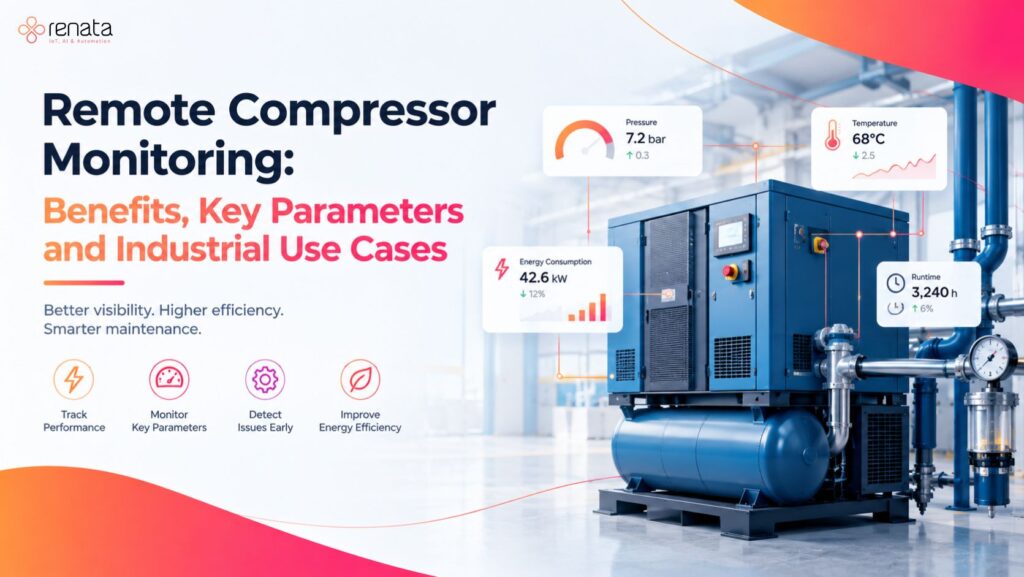
Industrial air compressors play an important role in manufacturing operations. They power pneumatic tools, support production equipment, operate automation systems and supply compressed air for a wide range of industrial processes. When compressor performance becomes unstable, the effects can extend beyond the compressor room to production quality, operating costs and equipment availability.
Traditional inspection methods provide useful information, but manual checks alone may not reveal every performance change between inspections. Remote compressor monitoring helps manufacturers observe operating conditions, review performance trends and identify abnormal readings without relying entirely on physical inspections.
By collecting data from suitable sensors, controllers and connected equipment, a remote compressor monitoring system can give maintenance and operations teams a clearer view of compressor performance and compressed air demand.
This guide explains how remote compressor monitoring works, which parameters to track, the benefits it can provide and how manufacturers can implement it effectively.
What Is Remote Compressor Monitoring?
Remote compressor monitoring is the process of collecting and reviewing compressor operating data from a location away from the equipment itself. Depending on the system configuration, data may be available through a web dashboard, mobile interface, central control room or industrial monitoring platform.
A monitoring solution can use existing compressor controllers, additional sensors or a combination of both to collect information about equipment status and operating conditions.
Common monitoring parameters include:
- Operating and shutdown status
- Discharge pressure and system pressure
- Compressor temperature
- Runtime and load/unload cycles
- Electrical power consumption
- Airflow and compressed air demand
- Alarm events and fault codes
- Maintenance and service history
Not every compressor provides all these measurements by default. The available data depends on the compressor model, controller, instrumentation and monitoring platform.
The main objective is to make relevant operating information easier to access, helping teams identify changes, investigate problems and make informed maintenance and operational decisions.
Why Is Compressor Monitoring Important in Manufacturing?
Compressed air is used across many industrial environments, including automotive plants, metal fabrication facilities, food processing units, packaging operations, pharmaceutical production and electronics manufacturing.
A compressor problem can affect multiple machines if they depend on the same compressed air network. For example, a pressure drop may affect pneumatic actuators, air tools or production equipment that requires a consistent air supply.
Several operational challenges make compressor monitoring valuable.
1. Unexpected equipment interruptions
A compressor that stops unexpectedly can disrupt processes that depend on a continuous air supply. Monitoring operating status, alarms and relevant equipment parameters can help teams identify problems earlier and respond more quickly.
2. Unnecessary energy consumption
Compressors can consume significant electrical power. Inefficient operating schedules, excessive system pressure, air leaks and poorly matched supply and demand can contribute to energy waste.
The U.S. Department of Energy’s compressed air resources describe system optimization measures such as reducing leaks, managing pressure, improving controls and maintaining equipment.
3. Limited visibility into performance
Without historical operating data, teams may find it difficult to determine whether a compressor is operating differently from its normal pattern. Trends can help distinguish an isolated event from a recurring issue.
4. Reactive maintenance practices
When maintenance depends mainly on breakdowns or fixed inspection schedules, warning signs may go unnoticed between service visits. Monitoring can support condition-based maintenance by giving technicians additional evidence to review.
5. Difficulty managing multiple compressors
Facilities with multiple compressors may need to compare runtime, operating status, alarms and energy use across machines. Centralized visibility can make it easier to identify uneven utilization or equipment that requires investigation.
How Does a Remote Compressor Monitoring System Work?
A typical system follows a sequence of data collection, communication, visualization and response.
Step 1: Collect operating data
Sensors, compressor controllers and electrical meters collect the parameters available for each machine. These may include pressure, temperature, runtime, power consumption, flow and operating status.
Before implementation, verify which values are already available from the compressor controller and which require additional instrumentation.
Step 2: Transmit the data
The collected data is sent through a suitable industrial communication method to a gateway, local server or monitoring platform. Depending on the installation, communication may use wired industrial networks, Ethernet, wireless connections or supported controller interfaces.
Network reliability and access controls should be considered when selecting the communication architecture.
Step 3: Display data on a dashboard
The monitoring interface organizes the information into readable values, trends, machine status indicators and event histories. A multi-compressor installation may use a single view to compare equipment across the plant.
Step 4: Configure alerts and thresholds
Where supported, the system can generate notifications when a monitored value exceeds a defined threshold or a fault condition is detected. Thresholds should be based on manufacturer recommendations, operating requirements and site conditions.
Step 5: Review trends and take action
Maintenance and operations teams investigate unusual readings, check the equipment and document corrective actions. Monitoring data supports the decision-making process; it does not replace physical inspection, qualified diagnosis or required safety procedures.
Key Parameters to Monitor in an Industrial Compressor
The most useful parameters depend on compressor type, operating conditions and the requirements of the production process.
|
Parameter |
What it helps you understand |
|
Operating status |
Whether the compressor is running, stopped, loaded or unloaded, where available |
|
Discharge pressure |
Whether the compressor is producing air at the expected pressure |
|
System pressure |
Whether the compressed air network is maintaining the pressure required by downstream equipment |
|
Temperature |
Whether operating temperatures are changing or approaching configured limits |
|
Runtime |
How long the compressor operates over a selected period |
|
Load/unload cycles |
How often the compressor switches between loaded and unloaded states |
|
Electrical power |
How much electrical energy the equipment consumes |
|
Airflow |
How much compressed air is being supplied or consumed, when flow measurement is installed |
|
Alarm and fault history |
Which abnormal events have occurred and how frequently they recur |
|
Dew point |
Whether compressed air drying performance meets process requirements, when measured |
Pressure monitoring
Pressure is one of the most important parameters in a compressed air system. If pressure falls below the level required by production equipment, tools and pneumatic systems may not operate as expected.
Monitoring pressure at the compressor alone may not reveal losses across the distribution network. For that reason, some installations also measure pressure at the receiver, main distribution line or critical points of use.
Repeated pressure drops should prompt investigation into demand changes, restrictions, leaks, control settings and equipment performance rather than an automatic increase in system pressure.
Temperature monitoring
Compressor temperature readings can help maintenance teams recognize unusual operating conditions. The exact measurement point matters: discharge temperature, lubricant temperature, motor temperature and ambient temperature describe different conditions.
Compare readings against the manufacturer’s specified operating limits and historical trends. A change in temperature is a reason to investigate, not proof of a particular fault.
Runtime and load/unload cycles
Runtime data helps teams understand equipment utilization and maintenance requirements. Load/unload patterns can also help identify possible mismatches between compressor capacity and demand.
For example, frequent cycling or extended unloaded operation may justify reviewing compressor sizing, control settings, air demand and the condition of the distribution system.
Energy consumption
Monitoring electrical power and energy use helps facilities understand how much electricity compressor equipment consumes over time.
Where airflow data is also available, teams can compare energy consumption with the volume of air delivered. This provides a more meaningful view of system performance than looking at electricity consumption alone.
Airflow and system demand
Flow measurement can help identify changes in compressed air demand, compare consumption across production areas and investigate potential leakage.
A sudden increase in airflow during non-production periods may indicate air use that deserves investigation. However, scheduled cleaning, automated equipment and legitimate overnight demand should be considered before concluding that a leak exists.
Dew point and compressed air quality
Some manufacturing processes require compressed air to meet specific dryness and quality requirements. Dew point monitoring can help verify dryer performance and identify conditions that may affect downstream processes.
Where product quality or regulatory requirements apply, monitoring should follow the relevant specifications and validated measurement procedures.
Benefits of Remote Compressor Monitoring
Remote monitoring can improve visibility and support better operational decisions when the right parameters are measured and teams respond to the findings.
1. Better visibility into equipment status
Operators and maintenance teams can review available operating information without needing to visit every compressor location. This is particularly useful for large plants, distributed facilities or compressor rooms with multiple machines.
2. Earlier investigation of abnormal conditions
Changes in pressure, temperature, runtime or alarm frequency can highlight conditions that need attention. Identifying these changes earlier may help teams investigate issues before they cause a larger operational disruption.
Monitoring does not guarantee that every failure can be predicted or prevented. Its value depends on data quality, appropriate thresholds and timely follow-up.
3. More informed maintenance planning
Historical data can help technicians understand how equipment has been operating, identify recurring alarms and prioritize inspections.
Combining monitoring information with service records, manufacturer guidance and physical inspection can support a more condition-based maintenance approach.
4. Improved energy management
Monitoring power consumption, runtime, pressure and airflow can help identify opportunities to improve compressed air system efficiency.
Potential areas for investigation include excessive pressure, unnecessary operation during idle periods, air leakage, inappropriate air use and inefficient compressor sequencing.
Actual savings depend on the problems identified, the actions taken and the site’s operating conditions.
5. Easier comparison across multiple compressors
Where data is available in a common dashboard, teams can compare equipment operating hours, alarm frequency, energy use and other relevant measurements. This can help identify machines that operate disproportionately or require further assessment.
6. More useful historical records
Stored data makes it easier to review what happened before an event, compare performance across shifts and determine whether an intervention changed operating behavior.
7. Better coordination between maintenance and production
A shared view of compressor status and operating history can help maintenance teams coordinate inspections and repairs with production requirements. Clear records of alarms, observations and corrective actions also improve follow-up.
Industrial Use Cases for Remote Compressor Monitoring
Remote compressor monitoring can support different operational objectives depending on the industry and compressed air application.
Automotive manufacturing
Automotive production lines use compressed air for pneumatic tools, actuators, material handling and other processes. Monitoring can help teams track compressor availability, pressure stability and operating trends that may affect production equipment.
For plants with multiple compressors, centralized visibility can also help maintenance teams compare equipment utilization.
Food and beverage manufacturing
Compressed air may support packaging, conveying, instrumentation and other operations. Where air contacts products or product-contact surfaces, the required air quality must be defined and verified for the application.
Monitoring pressure, dryer performance and relevant air-quality parameters can support operational control, but it does not replace the necessary filtration, testing or hygiene procedures.
Pharmaceuticals and electronics
Some pharmaceutical and electronics processes have strict requirements for compressed air quality, moisture and contamination control. Monitoring can help track relevant conditions and maintain records, provided the measurement system is appropriate for the required specification.
Metal fabrication and machining
Compressed air supports pneumatic tools, cleaning operations, automation and equipment functions. Monitoring runtime, pressure, energy consumption and demand can help teams investigate operating inefficiencies and identify changes that affect tool performance.
Packaging and general manufacturing
Packaging lines often depend on pneumatic actuators and automated machinery. Monitoring can help maintenance teams investigate pressure fluctuations, repeated alarms and unusual compressor cycling that may be associated with production interruptions.
Facilities with multiple compressor rooms
Sites with compressors distributed across separate buildings or production areas may benefit from a centralized view of available operating data. The communication design must account for connectivity, cybersecurity, data retention and what happens when the network is unavailable.
Remote Compressor Monitoring and Predictive Maintenance: What’s the Difference?
Remote monitoring and predictive maintenance are related, but they are not the same.
Remote compressor monitoring makes equipment data available for review. It helps teams observe status, compare trends and identify conditions that may need investigation.
Predictive maintenance uses condition information, historical patterns and suitable analytical methods to estimate developing faults or the likelihood of future equipment problems. Depending on the application, this may involve rules, statistical models or machine-learning techniques.
A remote monitoring system can provide useful inputs for a predictive maintenance program, but a dashboard alone does not automatically predict failures.
Manufacturers looking to extend monitoring into a broader maintenance strategy can explore Renata IoT’s predictive maintenance solutions.
How to Implement Remote Compressor Monitoring
A practical implementation should begin with a clear operational objective rather than collecting every possible measurement.
Step 1: Identify the business problem
Determine what you want to improve. Common objectives include:
- Reducing unplanned compressor-related interruptions
- Investigating recurring pressure drops
- Understanding compressor energy consumption
- Comparing utilization across multiple machines
- Improving maintenance planning
- Tracking dryer performance or compressed air quality
Define how success will be measured before choosing the monitoring setup.
Step 2: Audit the existing compressor system
Document compressor types, capacities, controller capabilities, operating schedules, pressure requirements, air receivers, dryers and distribution networks.
Identify which data points are already available and which require additional sensors or meters. Consult the equipment manufacturer or a qualified compressed air specialist where necessary.
Step 3: Select the right parameters
Prioritize measurements that relate directly to the business problem. A facility investigating pressure instability may need pressure readings at multiple locations, while an energy-efficiency project may require electrical energy and airflow measurements.
Avoid collecting data that cannot be interpreted or linked to an operational decision.
Step 4: Choose the communication and monitoring architecture
Confirm compatibility with existing controllers, sensors and industrial networks. Consider connectivity reliability, cybersecurity, user access, data storage, integration requirements and what happens during communication failures.
Remote access should be configured according to the organization’s IT and operational technology security policies.
Step 5: Establish baseline performance
Collect data across representative production schedules and operating conditions. Record normal ranges, production demand, shift patterns and known maintenance events.
A baseline provides a reference for identifying meaningful deviations. It also helps avoid confusing normal production changes with equipment faults.
Step 6: Configure alerts and responsibilities
Define which conditions require notifications, who receives them and how they should respond. Set limits based on engineering requirements and operating experience rather than arbitrary values.
Each important alert should have a clear investigation and escalation process.
Step 7: Pilot the solution
Start with one compressor or a small group of machines. Verify sensor readings, compare them with trusted instruments, confirm timestamps and test alert behavior.
Use the pilot to refine dashboards, thresholds and team workflows before expanding across the facility.
Step 8: Review performance and improve
Review the collected data regularly. Investigate recurring events, document corrective actions and compare relevant KPIs against the baseline.
Expand the monitoring scope when the initial system produces actionable information and the team has a reliable process for using it.
KPIs to Measure Compressor Monitoring Performance
Monitoring becomes more useful when the data is linked to measurable operational outcomes.
|
KPI |
How to use it |
|
Compressor availability |
Track the proportion of planned operating time the compressor is available for use |
|
Unplanned downtime |
Record compressor-related interruptions over a defined period |
|
Energy consumption |
Measure electricity used by the compressor system over time |
|
Specific energy consumption |
Where reliable power and airflow data are available, compare energy input with compressed air delivered |
|
Pressure stability |
Track pressure variation at relevant points against the process requirement |
|
Loaded versus unloaded runtime |
Review utilization patterns and possible capacity or control mismatches |
|
Alarm frequency |
Identify recurring abnormal events that require investigation |
|
Maintenance response time |
Measure the time between an alert or reported issue and the start of investigation |
|
Compressed air leakage indicators |
Use appropriate flow, pressure or leak-survey methods to assess suspected losses |
|
Repeat fault rate |
Track whether the same issue recurs after corrective action |
Use consistent measurement periods and operating conditions when comparing results. A reduction in energy use, for example, may reflect lower production demand rather than an improvement in compressor efficiency. Where possible, compare energy data with production output or compressed air delivered.
Common Challenges and How to Address Them
Incomplete or unreliable data
Missing readings, incorrectly installed sensors and inconsistent timestamps can lead to misleading conclusions. Validate measurements and establish a process for handling missing or implausible values.
Too many alerts
Excessive notifications can cause alert fatigue. Prioritize alerts by operational significance, set thresholds appropriately and review recurring notifications to determine whether they need adjustment.
Limited compatibility with older equipment
Legacy compressors may not expose all required data through their controllers. A technical assessment can identify whether supported interfaces, external sensors or electrical meters are suitable.
Weak connectivity
Communication interruptions can create gaps in remote visibility. Consider local buffering, clear communication-status indicators and a defined process for operating safely when remote data is unavailable.
Data without action
A dashboard provides limited value if nobody reviews the readings or owns the follow-up process. Assign responsibilities for investigating alerts, recording findings and tracking corrective actions.
Unclear return on investment
The financial value of monitoring depends on the site’s current problems and the improvements that follow. Establish a baseline for energy, downtime and maintenance before deployment, then evaluate actual results instead of assuming a fixed percentage of savings.
How to Choose a Remote Compressor Monitoring Solution
Before selecting a platform, assess the requirements of your compressor installation and the capabilities of the proposed system.
Consider the following:
- Parameter coverage: Does it support the pressure, temperature, runtime, energy, airflow or other measurements you need?
- Compatibility: Can it integrate with your compressor controllers and existing industrial instrumentation?
- Data visibility: Can users review live values, historical trends, alarm records and equipment status?
- Alerts: Can thresholds and notifications be configured for your operating conditions?
- Multi-machine support: Can the system present information from multiple compressors in a consistent view?
- Integration: Does it support the required connections to existing monitoring or maintenance systems?
- Cybersecurity: Are user permissions, remote-access controls and network requirements clearly documented?
- Scalability: Can additional machines or measurements be included as requirements change?
- Reporting: Can the team export or review information needed for maintenance and energy analysis?
- Implementation support: Are sensor installation, commissioning, training and ongoing support available?
Ask suppliers to demonstrate the actual features included in the proposed configuration. Capabilities such as automatic diagnostics, predictive analytics, remote control or integration with third-party systems should be confirmed rather than assumed.
Remote Compressor Monitoring with Industrial IoT
Industrial IoT connects equipment, sensors and monitoring applications so operational data can be collected and used across a facility.
For compressor monitoring, an IoT-based architecture may combine controller data, additional sensors, communication gateways and a dashboard to provide a consolidated view of equipment performance.
When integrated with broader industrial monitoring, compressor data can be reviewed alongside machine status, production schedules and energy information. This may help teams investigate whether changes in compressed air demand align with production activity.
The specific benefits depend on the data available, system integration and the processes used to interpret the information. Industrial IoT is most effective when it supports defined operational decisions rather than simply adding more dashboards.
Learn more about Renata IoT’s compressor monitoring solutions and explore related machine monitoring capabilities.
Frequently Asked Questions
1. What is remote compressor monitoring?
Remote compressor monitoring collects operating data from compressors and makes it available through a remote dashboard or monitoring platform. Depending on the configuration, it can track parameters such as operating status, pressure, temperature, runtime, energy use and alarms.
2. Which parameters should be monitored in an industrial air compressor?
Common parameters include discharge and system pressure, temperature, operating status, runtime, load/unload cycles, electrical power, airflow and alarm history. Dew point and other air-quality parameters may be important for applications with specific compressed air quality requirements.
3. Can remote compressor monitoring reduce energy costs?
It can help identify potential sources of energy waste, including leaks, excessive pressure, unnecessary runtime and inefficient operating patterns. Cost reductions depend on the findings, corrective actions, production requirements and energy prices.
4. Can remote monitoring predict compressor failures?
Remote monitoring can reveal abnormal readings and trends that warrant investigation. Predictive maintenance requires additional analysis and appropriate diagnostic methods; monitoring alone cannot guarantee that failures will be predicted.
5. Can older compressors be monitored remotely?
Some older compressors can be monitored using supported controller interfaces, external sensors or electrical meters. Feasibility depends on the equipment, available signals, installation requirements and compatibility with the monitoring platform.
6. Is airflow measurement necessary for compressor energy monitoring?
Not for every monitoring objective. Electrical energy measurements can show how much energy a compressor uses, while airflow measurement helps relate that energy to the amount of compressed air delivered. Combining the two provides a more informative efficiency measure when the measurements are reliable and comparable.
7. How should manufacturers get started?
Begin by defining the main problem, auditing existing equipment and selecting the most relevant measurements. Establish a baseline, pilot the monitoring setup, validate readings and assign responsibility for responding to alerts before scaling up.
Conclusion
Remote compressor monitoring gives manufacturers a practical way to improve visibility into equipment operation, review performance trends and investigate abnormal conditions. By tracking relevant parameters such as pressure, temperature, runtime, energy consumption and airflow, teams can make better-informed decisions about maintenance and compressed air system performance.
The best results come from combining reliable measurements with clear alert rules, qualified investigation and regular performance reviews. Monitoring should complement equipment inspections, manufacturer recommendations and established maintenance procedures—not replace them.
If your facility wants to improve visibility into compressor performance and industrial equipment operation, explore Renata IoT’s compressor monitoring solution or contact the Renata IoT team to discuss your requirements.