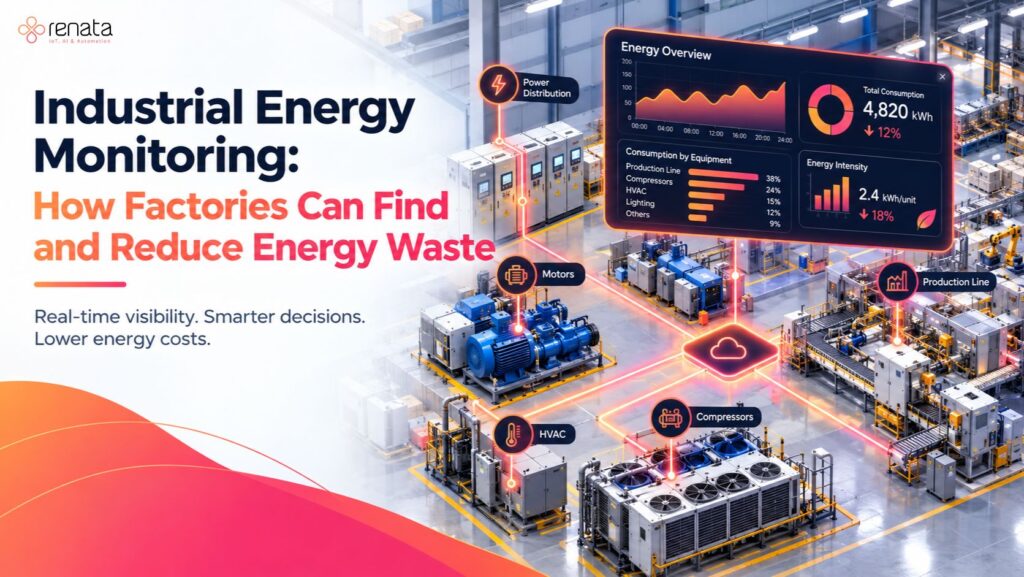
Energy is a major operating expense for many manufacturing facilities. Production machinery, compressors, pumps, motors, HVAC systems, lighting and other industrial equipment can consume significant amounts of electricity throughout the day.
Yet many factories still rely primarily on monthly electricity bills, periodic meter readings or manually collected data to understand their energy consumption.
These sources show how much energy a facility has used, but they may not explain which machines consume the most, when consumption rises unexpectedly or whether energy use is aligned with actual production.
Industrial energy monitoring helps manufacturers move from occasional energy reviews to data-driven energy management. By collecting and analyzing energy consumption data, businesses can better understand usage patterns, identify unusual changes and investigate opportunities to improve efficiency.
In this guide, we explore how industrial energy monitoring works, which equipment to monitor, what metrics to track and how manufacturers can use energy data to support better operational decisions.
What Is Industrial Energy Monitoring?
Industrial energy monitoring is the process of measuring, collecting and analyzing energy consumption across a factory, production line, machine or individual piece of equipment.
Depending on the setup, a monitoring system may use electrical meters, power meters, connected sensors, industrial gateways and software dashboards to collect energy data.
The information can help teams understand:
- How much electricity a facility consumes.
- Which production lines or machines use the most energy.
- How energy consumption changes throughout a shift.
- Whether equipment continues consuming power during idle periods.
- When consumption patterns differ from normal operating conditions.
- How energy use compares with production output.
- Whether an energy-efficiency improvement produces measurable results.
A basic system may monitor total facility consumption, while a more detailed deployment can provide visibility into individual machines or production processes.
The appropriate level of monitoring depends on the facility’s objectives, electrical infrastructure, measurement requirements and budget.
Why Is Energy Monitoring Important for Manufacturing?
A monthly electricity bill provides an overall view of consumption and cost. However, it usually does not provide enough detail to explain the operational reasons behind those figures.
For example, a factory may notice that its electricity bill has increased. Without more detailed information, the energy manager may struggle to determine whether the change came from longer production hours, additional machinery, inefficient equipment, higher demand or avoidable consumption during idle periods.
Industrial energy monitoring helps break overall consumption into more useful information.
1. Identify Where Energy Is Being Consumed
A factory-wide meter shows total usage. Submetering can help separate consumption by department, production line or equipment group.
This allows teams to investigate where energy is being used and prioritize areas with the greatest potential for improvement.
2. Detect Unusual Consumption Patterns
Unexpected increases in energy consumption can indicate a change in operating conditions, equipment behavior, production schedules or other factors.
Monitoring helps teams identify these changes earlier than they might through periodic manual reviews. However, an unusual reading is a signal to investigate, not proof that a machine is faulty.
3. Understand Energy Use During Idle Periods
Some equipment continues consuming electricity when production is paused or when a line is not actively producing.
Monitoring can reveal these periods and help teams evaluate whether equipment shutdown procedures, standby settings or operating schedules should be reviewed.
Any changes must respect safety, process requirements and equipment manufacturers’ instructions.
4. Compare Energy Consumption With Production
Energy consumption alone does not always show whether a factory is operating efficiently.
A production line that uses more electricity may also be producing significantly more output. Comparing energy consumption with production volume provides a more useful performance measure.
5. Support Continuous Improvement
Energy data provides a baseline against which manufacturers can assess operational changes, equipment upgrades and efficiency initiatives.
This data-driven approach is consistent with the broader principles of energy management described in ISO 50001, which provides a framework for monitoring and continually improving energy performance.
Reference: ISO 50001 — Energy Management Systems.
How Does an Industrial Energy Monitoring System Work?
An industrial energy monitoring system typically follows a sequence from measurement to analysis and action.
Step 1: Measure Energy Consumption
Meters or compatible measurement devices collect electrical parameters from the facility or selected equipment.
Depending on the device, available measurements may include:
- Voltage
- Current
- Active power
- Energy consumption in kWh
- Power factor
- Frequency
- Maximum demand
Not every meter provides every parameter. The measurement requirements should be defined before selecting the hardware.
Step 2: Collect and Transmit Data
The measurement devices send readings to a monitoring platform through supported communication methods.
The architecture may include industrial gateways, wired connections or wireless communication, depending on the equipment and site conditions.
Where data comes from different devices, compatible protocols and proper configuration are important for reliable collection.
Step 3: Display Energy Data
The monitoring software presents collected readings through dashboards, trends, charts or reports.
Users may be able to view facility-level consumption, compare equipment groups, review historical data and identify changes in operating patterns.
Available functions depend on the selected solution and its configuration.
Step 4: Analyze Consumption Patterns
Energy managers and operations teams review the data to identify opportunities for improvement.
For example, a production line may show unusually high energy use during non-production hours. The team can compare this pattern with operating schedules and investigate whether equipment is being left running unnecessarily.
Step 5: Take Corrective Action and Verify Results
Once an opportunity is identified, the team can evaluate a suitable action, implement it and compare energy performance before and after the change.
This final step is important: monitoring creates visibility, but measurable improvement requires investigation, action and follow-up.
What Equipment Should Factories Monitor?
The best monitoring strategy begins with equipment that consumes significant energy, operates for long periods or has a known history of inefficiency.
Motors and Production Machinery
Electric motors power many industrial processes, including conveyors, mixers, machine tools and production equipment.
Monitoring their energy consumption can help teams understand operating patterns and investigate changes in usage.
Air Compressors
Compressed-air systems can be important energy consumers in manufacturing facilities.
Monitoring compressor power consumption alongside operating hours and, where available, pressure and flow data can help teams investigate inefficient operation, leaks, excessive pressure settings or unnecessary running time.
Learn more about compressor monitoring and the role of equipment-level visibility in industrial operations.
Pumps and Fans
Pumps and fans are used across cooling, ventilation, water handling and process applications.
Monitoring can help teams compare consumption across operating conditions and investigate whether equipment is operating as expected.
HVAC and Cooling Systems
Heating, ventilation and cooling systems may operate for long periods, depending on the facility and process requirements.
Energy monitoring can help reveal consumption patterns associated with operating schedules, environmental conditions and changes in demand.
Furnaces and Process Heating
Energy monitoring can support analysis of electrical consumption in electrically powered heating systems. Facilities using gas or other fuels may require additional meters or instrumentation to capture total energy use accurately.
Entire Production Lines
Line-level monitoring helps manufacturers compare energy consumption with output, operating time and production schedules.
This can make it easier to identify which lines deserve a more detailed energy review.
Key Energy Metrics Every Factory Should Track
Choosing the right metrics is more important than collecting as much data as possible.
|
Metric |
What It Measures |
How It Helps |
|
Energy consumption (kWh) |
Electrical energy used over a period |
Tracks total usage and historical trends |
|
Active power (kW) |
Rate of electricity consumption at a point in time |
Helps identify high-load periods |
|
Maximum demand (kW or kVA) |
Highest demand measured over a defined interval, depending on the tariff and meter |
Helps investigate demand-related charges |
|
Power factor |
Relationship between active and apparent power |
Helps assess electrical system performance |
|
Energy intensity (kWh per unit) |
Energy used per unit of production |
Supports production-adjusted comparisons |
|
Idle energy consumption |
Energy used during defined non-production periods |
Helps identify opportunities to review standby operation |
|
Peak-period consumption |
Energy used during specified peak tariff periods |
Supports analysis of time-based energy costs |
|
Energy cost |
Energy-related expenditure based on applicable billing rules |
Connects consumption data with operating expenses |
Metric definitions and measurement intervals should be consistent across reports. Electricity tariffs, demand-charge rules and billing calculations vary, so cost calculations should be aligned with the facility’s actual tariff.
How to Calculate Energy Consumption per Unit of Production
One useful metric is energy intensity: the amount of energy consumed to produce a unit of output.
The basic formula is:
Energy intensity = Total energy consumed ÷ Units produced
For example, suppose a production line consumes 2,400 kWh during a shift and produces 1,200 units.
Energy intensity is:
2,400 kWh ÷ 1,200 units = 2 kWh per unit
If the same line consumes 2,200 kWh while producing 1,200 units in a comparable shift, its energy intensity becomes approximately 1.83 kWh per unit.
This indicates lower energy consumption per unit of output for that period. Before concluding that efficiency has improved, compare equivalent products, operating conditions, production quality and other relevant factors.
For factories that manufacture different products, it may be necessary to calculate energy intensity separately by product type or use an appropriate production-weighted measure.
Common Signs of Energy Waste in Factories
Energy monitoring can help identify patterns that deserve further investigation.
High Consumption During Non-Production Hours
If a machine or production line continues drawing significant power while production is stopped, review whether the equipment is required to remain operational.
Some systems must remain active for safety, process stability, temperature control or restart requirements, so shutdown decisions should be based on approved operating procedures.
Rising Energy Use for Similar Production Output
If energy consumption increases while output and product mix remain comparable, investigate possible causes such as equipment condition, operating settings, process changes or measurement errors.
Unusual Peaks in Electrical Demand
Short periods of high demand may occur when several large loads start or operate simultaneously.
Reviewing demand trends can help identify whether equipment sequencing or operating schedules deserve further assessment.
Equipment Running Longer Than Expected
Extended operating hours can increase energy consumption even when the equipment is functioning normally.
Comparing operating schedules with energy data can help identify unnecessary running time or opportunities to adjust schedules.
Large Differences Between Similar Machines
If two comparable machines perform similar tasks but show substantially different energy use, investigate differences in load, settings, condition, output and measurement accuracy.
The goal is to understand the cause before recommending an operational change.
How to Implement Industrial Energy Monitoring
Manufacturers do not need to instrument every machine at once. A phased approach can help demonstrate value before expanding the system.
Step 1: Define the Business Objective
Start by identifying the problem the factory wants to solve.
Examples include understanding rising electricity costs, monitoring energy-intensive machines, reducing idle consumption, improving demand management or measuring energy per unit of output.
Clear objectives help determine which measurements are necessary.
Step 2: Review Existing Energy Data
Collect available electricity bills, meter readings, equipment lists, production schedules and operating records.
This creates an initial picture of consumption and helps identify gaps in the current measurement approach.
Step 3: Identify Priority Equipment
Prioritize equipment based on available consumption information, operating hours, process importance and potential improvement opportunities.
If the factory lacks equipment-level data, a temporary measurement exercise or an initial submetering deployment may help establish priorities.
Step 4: Select Suitable Metering and Monitoring Technology
Confirm that the selected meters are appropriate for the electrical system, expected load, installation environment and measurement objectives.
Evaluate the platform’s supported devices, communication methods, data resolution, dashboard functions, historical storage and integration requirements.
Electrical installations should be assessed and carried out by appropriately qualified personnel.
Step 5: Establish a Baseline
Collect data over a representative period and document relevant operating conditions.
A useful baseline should account for factors such as production volume, operating hours, product mix and seasonal influences where relevant.
Without a suitable baseline, it can be difficult to determine whether later changes represent genuine improvement.
Step 6: Configure Dashboards and Alerts
Set up dashboards around the questions users need to answer.
Examples include:
- Which production line consumed the most energy during the last shift?
- Did consumption rise during non-production hours?
- How does energy per unit compare with the baseline?
- Did a machine’s power demand change unexpectedly?
Configure thresholds and notifications only where they are useful and supported by the system. Thresholds should reflect the equipment’s normal operating conditions rather than arbitrary limits.
Step 7: Investigate and Act on Findings
Assign responsibility for reviewing unusual readings and prioritizing improvement opportunities.
Possible actions may include adjusting operating schedules, reviewing compressed-air performance, checking equipment condition or investigating process settings.
Do not assume that every increase in energy consumption indicates a fault. Interpret the data alongside operating context.
Step 8: Verify the Results
Compare post-change performance with the baseline under comparable conditions.
Document what changed, when it changed and which factors may have influenced the results.
This turns energy monitoring from a dashboard exercise into a repeatable improvement process.
Industrial Energy Monitoring vs. Energy Management
These terms are related, but they serve different purposes.
|
Industrial Energy Monitoring |
Energy Management |
|
Measures and displays energy use |
Establishes objectives, responsibilities and improvement plans |
|
Helps identify consumption patterns |
Determines which opportunities should be prioritized |
|
Provides data for investigation |
Coordinates actions to improve performance |
|
Tracks energy metrics |
Reviews results and supports continual improvement |
Monitoring provides information. Energy management uses that information, together with operational knowledge and defined processes, to make and sustain improvements.
A structured energy management program can use monitoring data to support energy reviews, performance indicators and ongoing evaluation. ISO 50001 provides a recognized framework for this systematic approach.
Read more from the International Organization for Standardization on ISO 50001.
How Industrial IoT Supports Energy Monitoring
Industrial Internet of Things (IoT) technologies can help connect energy meters and other measurement devices to centralized monitoring platforms.
Depending on the architecture, connected systems may support:
- Remote collection of meter readings.
- Centralized dashboards for multiple machines or locations.
- Historical trends and reporting.
- Notifications when configured thresholds are crossed.
- Integration with selected industrial systems.
- Comparisons between energy consumption and equipment operation.
Not every IoT monitoring solution includes all these capabilities. Device compatibility, network connectivity, software features and system integration must be verified during planning.
For manufacturers pursuing broader operational visibility, energy monitoring may complement machine monitoring and other industrial data initiatives.
How to Choose an Industrial Energy Monitoring Solution
The right solution should fit the factory’s measurement requirements and operational environment.
Before making a decision, consider the following:
- Measurement coverage
Can the solution measure energy at the facility, department, production-line and equipment levels required by the business?
- Device compatibility
Does it support the meters, sensors, gateways and communication protocols used at the site?
- Data visibility
Can the team review current readings, historical trends and relevant performance metrics without excessive manual work?
- Alerting and reporting
Can users configure useful thresholds, receive relevant notifications and generate reports for energy reviews?
- Integration requirements
Will the system need to exchange data with production monitoring, maintenance software, building systems or existing reporting tools?
- Scalability
Can the deployment expand to additional machines, production lines or facilities without requiring an entirely new approach?
- Data reliability and security
Evaluate measurement accuracy, data quality, user permissions, network security, backup arrangements and data retention.
- Implementation support
Clarify the responsibilities for installation, configuration, commissioning, training and ongoing maintenance.
- Total cost of ownership
Consider hardware, installation, software, connectivity, integration and ongoing support costs—not just the initial purchase price.
A practical evaluation should use the factory’s actual requirements and a clearly defined pilot rather than relying on feature lists alone.
How to Measure the Success of an Energy Monitoring Project
Before implementation, define how success will be measured.
Useful indicators include:
- Energy consumption per unit of production.
- Total energy consumption over comparable operating periods.
- Consumption during non-production hours.
- Peak demand and demand-related costs, where applicable.
- Percentage of priority equipment covered by monitoring.
- Number of identified opportunities investigated.
- Verified energy savings after corrective actions.
- Time required to identify and investigate unusual consumption.
Important: Installing an energy monitoring system does not automatically reduce energy consumption. Savings depend on the opportunities identified, the actions implemented and the results verified against an appropriate baseline.
Where energy performance is a formal business objective, consistent measurement and review are essential.
Frequently Asked Questions
1. What is industrial energy monitoring?
Industrial energy monitoring is the measurement and analysis of energy consumption across a factory, production line or individual machine. It helps manufacturers understand usage patterns, investigate unusual consumption and evaluate opportunities to improve efficiency.
2. Can energy monitoring help reduce electricity costs?
It can help identify opportunities to reduce unnecessary consumption and investigate demand-related costs. Actual savings depend on the findings, the corrective actions taken, the electricity tariff and the conditions under which performance is measured.
3. What is real-time energy monitoring?
Real-time energy monitoring provides frequently updated energy measurements through a monitoring platform. The actual update interval depends on the meter, communication system and software configuration; not every system provides instantaneous readings.
4. Which machines should a factory monitor first?
Start with equipment that appears to consume significant energy, operates for long periods, supports critical production processes or has known efficiency concerns. The priority should be confirmed using available measurements and operating information.
5. What is the difference between energy monitoring and energy auditing?
Energy monitoring collects and analyzes energy-use data over time. An energy audit is a structured assessment of energy consumption, systems and potential improvement opportunities. Monitoring can support an audit, but it does not replace the full scope of an audit where one is required.
6. Is industrial energy monitoring useful for small and medium-sized factories?
Yes. A factory can begin with a few priority machines or production lines and expand after evaluating the usefulness of the data. The scope should match the facility’s objectives and resources.
7. Does industrial energy monitoring require IoT?
No. Energy can be measured using standalone meters and other conventional systems. IoT connectivity can make it easier to collect, centralize and review data remotely, depending on the deployment.
8. How long does it take to implement an energy monitoring system?
The timeline depends on the number of measurement points, electrical installation requirements, device compatibility, network availability, integration complexity and commissioning process. A limited pilot can help estimate the effort required for a broader deployment.
Conclusion: Turn Energy Data Into Better Factory Decisions
Industrial energy monitoring gives manufacturers a clearer view of where and when energy is being consumed. By measuring priority equipment, comparing consumption with production and investigating unusual patterns, factories can make more informed decisions about operational efficiency.
The most practical starting point is to define a clear objective, identify priority equipment, establish a baseline and use the collected data to investigate specific opportunities.
Over time, consistent measurement and follow-up can help manufacturers build a more systematic approach to energy performance.
Want to improve visibility into your factory’s energy consumption?
Explore Renata IoT’s Energy Monitoring solution to learn more about monitoring energy use in industrial environments. You can also contact the Renata IoT team to discuss your requirements.
References and Further Reading
- International Organization for Standardization (ISO): ISO 50001 — Energy Management Systems
https://www.iso.org/standard/69426.html - U.S. Department of Energy: Industrial Technologies Office Software Tools
https://www.energy.gov/cmei/ito/ito-software-tools - U.S. Department of Energy: Energy Management Programs
https://www.energy.gov/cmei/ito/energy-management-programs
These resources provide additional information on systematic energy management, industrial efficiency and tools that help manufacturers assess energy use and identify opportunities for improvement.